How to Start a Software Testing Career in 2026
_11zon.webp)
Understanding Software Testing
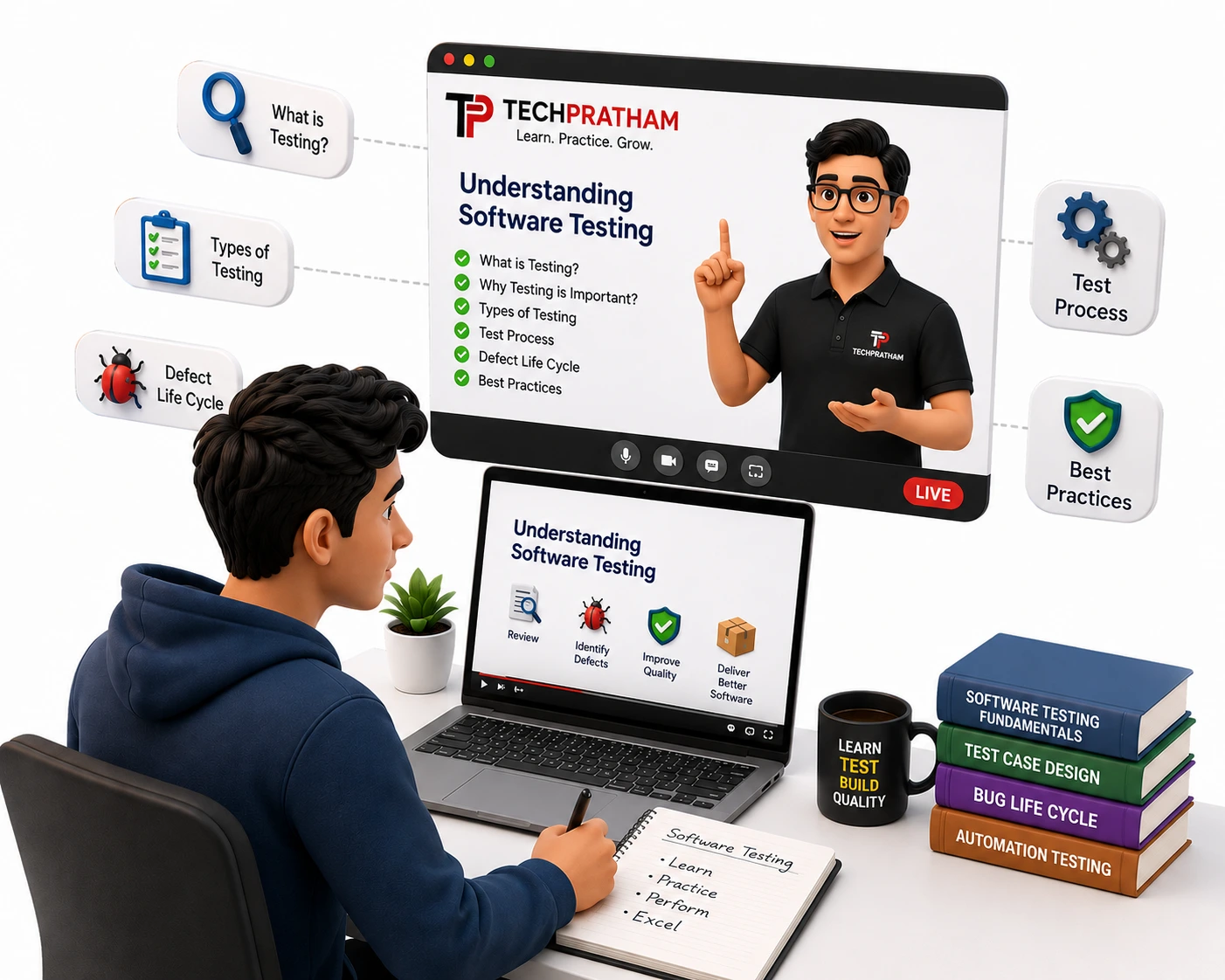
- Detecting defects before software reaches customers
- Improving product quality and reliability
- Enhancing user experience and customer satisfaction
- Reducing maintenance and support costs
- Preventing security vulnerabilities and data breaches
- Ensuring compliance with industry standards and regulations
- Supporting faster and safer software releases
Organizations across industries such as Banking, Healthcare, FinTech, E-commerce, EdTech, Telecommunications, and SaaS heavily rely on software testing to maintain the quality and stability of their applications.
The 2026 Evolution: Manual vs. Automation vs. SDET
To successfully build a career in software testing, you must first understand the modern hierarchy of the profession. Companies no longer just post generic jobs for "testers." Instead, they recruit for distinct skill profiles based on their technical maturity. To understand where you fit in, let us break down the three primary career tracks.
1. Manual QA Tester
- Coding Required: None.
- Core Skills: Analytical thinking, writing clear documentation, empathy for the end-user, and meticulous attention to detail.
- The 2026 Reality: While some tech gurus claim manual testing is dead, they are mistaken. AI cannot mimic human intuition or judge whether a user interface "feels" right. However, manual-only roles are highly competitive and generally offer lower starting salaries. Today, manual testing is usually a stepping stone toward automation.
2. Automation Engineer
- Coding Required: Basic to Intermediate.
- Core Skills: Proficiency in a programming language, familiarity with automation tools, and understanding element locators (how a script finds a button on a web page).
- The 2026 Reality: This is the baseline standard for mid-level QA positions. Companies expect testers to automate their regression suites (the library of tests run before every product release) to save time and speed up deployments.
3. The SDET (Software Development Engineer in Test)
At the top of the QA food chain sits the SDET. This role completely bridges the gap between a pure software developer and a pure tester. An SDET doesn't just write scripts to test an application; they build the entire infrastructure, frameworks, and tools that allow automation to happen seamlessly across massive engineering teams.
- Coding Required: Advanced (Developer-Grade).
- Core Skills: Software architecture, deep knowledge of data structures and algorithms, DevOps pipeline integration (CI/CD), and cloud computing.
- The 2026 Reality: SDETs are among the highest-paid professionals in tech, often commanding salaries identical to senior backend developers. They participate in code reviews, help design the application's architecture for "testability," and build internal tools to make the entire development team faster.
Your Step-by-Step Learning Roadmap
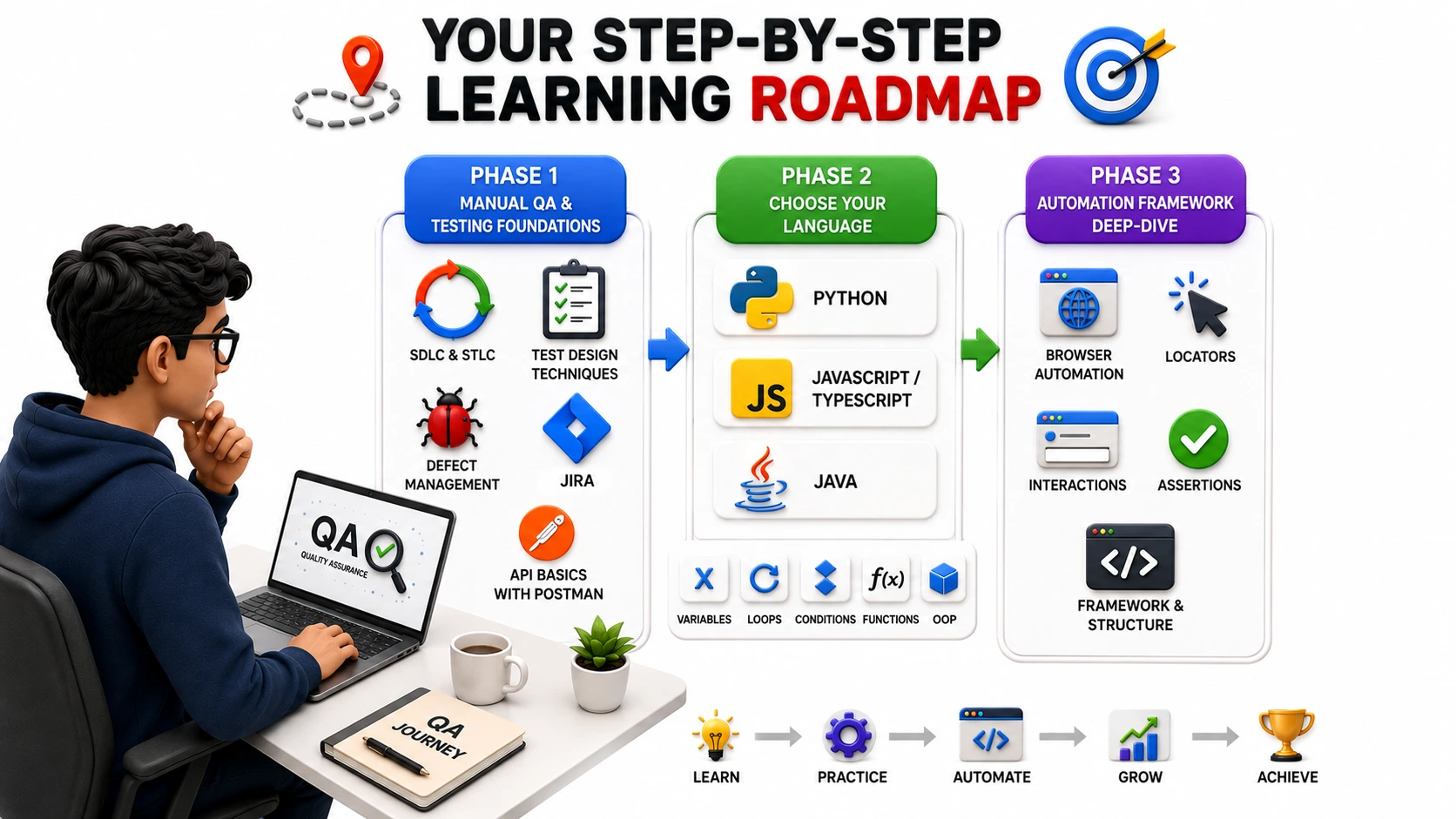
Trying to learn everything at once is the number one reason beginners give up on QA. If you jump straight into advanced code without understanding fundamental software testing principles, you will struggle to clear technical interviews.
1. Mastering Manual QA & Testing Foundations
- SDLC, STLC & Agile Methodology
- Test Design Techniques
- Defect Management & Jira
- API Testing with Postman
2. Choosing Your Programming Language
- Python for Test Automation
- JavaScript / TypeScript for Modern Testing
- Java for Enterprise Automation
- Core Programming Fundamentals & OOP
3. Automation Framework Deep-Dive
- Introduction to Test Automation Frameworks
- Browser Automation Fundamentals
- Web Element Identification & Interaction
- Test Assertions & Validation
Selenium vs. Playwright: The Technical Shift
The 2026 Paradigm: How AI is Changing Testing
One of the biggest concerns for aspiring testers is whether AI will replace software testing jobs. The reality is that AI is not replacing testers—it is transforming how they work. Testers who effectively use AI tools will have a significant advantage over those who don't. Today, AI helps QA professionals automate repetitive tasks, allowing them to focus on critical thinking, complex testing scenarios, and quality strategy.
AI-Powered Test Data Generation
AI can instantly generate large volumes of realistic test data, helping testers save time and improve test coverage.
Self-Healing Test Automation
Modern AI tools can automatically identify and fix broken test locators, reducing maintenance efforts and improving automation reliability.
Predictive Risk Analysis
By analyzing code changes and historical defects, AI can identify high-risk areas of an application, helping teams prioritize testing more effectively.
Why Software Testing Is More Important Than Ever
Modern software applications are more complex than ever before. A single application may include web interfaces, mobile apps, APIs, cloud services, databases, and third-party integrations. Even a small defect can lead to serious consequences such as financial losses, customer dissatisfaction, security breaches, or legal issues. This is why companies invest heavily in quality assurance. With faster release cycles driven by Agile and DevOps methodologies, testing has become a critical component of software development. Organizations need testers who can ensure quality while supporting rapid software delivery.
- Continuous Testing in CI/CD pipelines
- Test Automation for rapid feedback
- API Testing for microservices-based applications
- Performance Testing for scalable systems
- Security Testing for cyber threat prevention
- AI-assisted Testing and intelligent test generation
- Shift-Left Testing, where testing starts early in development
- Testim
- Mabl
- Functionize
- Applitools
- Tricentis
- Copado
Top Recommended Courses, Certifications & Resources
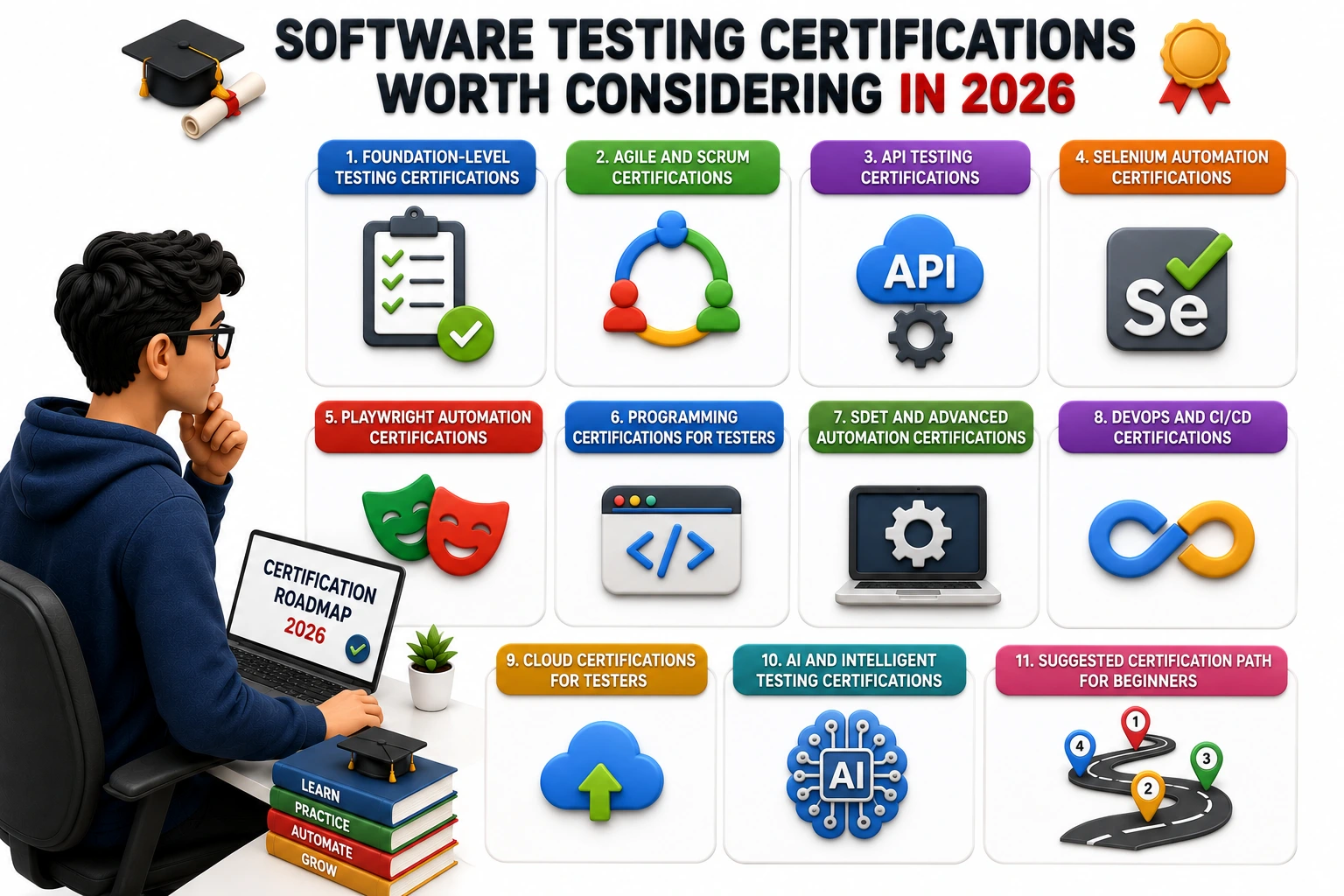
While certifications alone won't guarantee a job, they can help validate your skills, strengthen your resume, and demonstrate your commitment to learning. For beginners, certifications provide a structured learning path and help build confidence in core testing concepts. For experienced professionals, advanced certifications can support career growth into automation, SDET, Agile, DevOps, and AI-driven testing roles. The key is to view certifications as a complement to hands-on practice rather than a replacement for real-world projects and practical experience
Recommended Certifications for Software Testers
- ISTQB Foundation Level (CTFL)
- Agile or Scrum Certification
- Postman API Testing Certification
- Python or Java Programming Certification
- Selenium Automation Certification
- Playwright Automation Certification
- DevOps or Cloud Fundamentals Certification
- AI Testing or Generative AI Certification
Final Thought
Software testing in 2026 is far more than just finding and reporting bugs. It has evolved into a technology-driven profession that combines quality assurance, automation engineering, API testing, cloud technologies, DevOps practices, Artificial Intelligence, and software development skills. As organizations continue to accelerate digital transformation, the demand for skilled testing professionals remains strong across industries such as banking, healthcare, eCommerce, FinTech, SaaS, and telecommunications. The future of software testing belongs to professionals who are adaptable, continuously learning, and comfortable working alongside emerging technologies. AI may change how testing is performed, but it cannot replace the analytical thinking, business understanding, and problem-solving abilities that skilled testers bring to software development teams.
FAQ's
1. Is software testing a good career choice in 2026?
Yes. Software testing continues to be one of the most in-demand IT careers because every software application requires quality assurance before release. With the growing adoption of automation, cloud computing, and AI, testing professionals have access to diverse and well-paying career opportunities.
2. Can I start a software testing career without a programming background?
Absolutely. Most professionals begin with manual testing, where programming knowledge is not mandatory. However, learning a programming language such as Python, Java, or JavaScript becomes important when moving into automation testing, Playwright, Selenium, or SDET roles.
3. Which automation tool should I learn in 2026: Selenium or Playwright?
Both tools are valuable, but Playwright is becoming increasingly popular for modern web application testing due to its speed, reliability, built-in waiting mechanisms, and cross-browser support. Selenium remains widely used in enterprise organizations, making knowledge of both tools beneficial for long-term career growth.
4. Will AI replace software testers in the future?
No. AI is transforming software testing by automating repetitive tasks such as test data generation, test case creation, and script maintenance. However, testers are still needed to analyze requirements, design testing strategies, evaluate user experiences, and make quality-related decisions. Testers who use AI effectively will have a significant advantage in the industry.
5. What is the best learning roadmap for becoming a software tester in 2026?
A recommended roadmap is:
- Learn Manual Testing Fundamentals
- Understand SDLC, STLC, Agile, and Scrum
- Learn SQL and Database Testing
- Master API Testing with Postman
- Learn Programming (Python, Java, or JavaScript)
- Study Selenium and Playwright Automation
- Understand Git, CI/CD, and DevOps Basics
Related Articles

Is Software Testing Still a Good Career in 2026?
Explore whether software testing is still a good career in 2026. Learn about QA job demand, automation testing.

How AI is Transforming software testing in 2026
AI is transforming software testing in 2026 with smart automation, faster bug detection, self-healing scripts, and intelligent QA processes.