In today's competitive business environment, organizations manage thousands of activities every day, from handling customer orders and inventory to processing payments, managing employees, and generating financial reports. When these activities are managed through separate systems, businesses often face delays, errors, and communication challenges.
This is where SAP plays a crucial role.
SAP is one of the world's leading Enterprise Resource Planning (ERP) systems that helps organizations integrate different business functions into a single platform. By connecting departments and automating workflows, SAP enables businesses to improve efficiency, reduce manual work, and make data-driven decisions.
Because SAP is used by organizations worldwide, learning SAP through
SAP Training can help individuals understand how real business operations, finance, procurement, sales, inventory management, and HR processes are managed within an ERP environment.
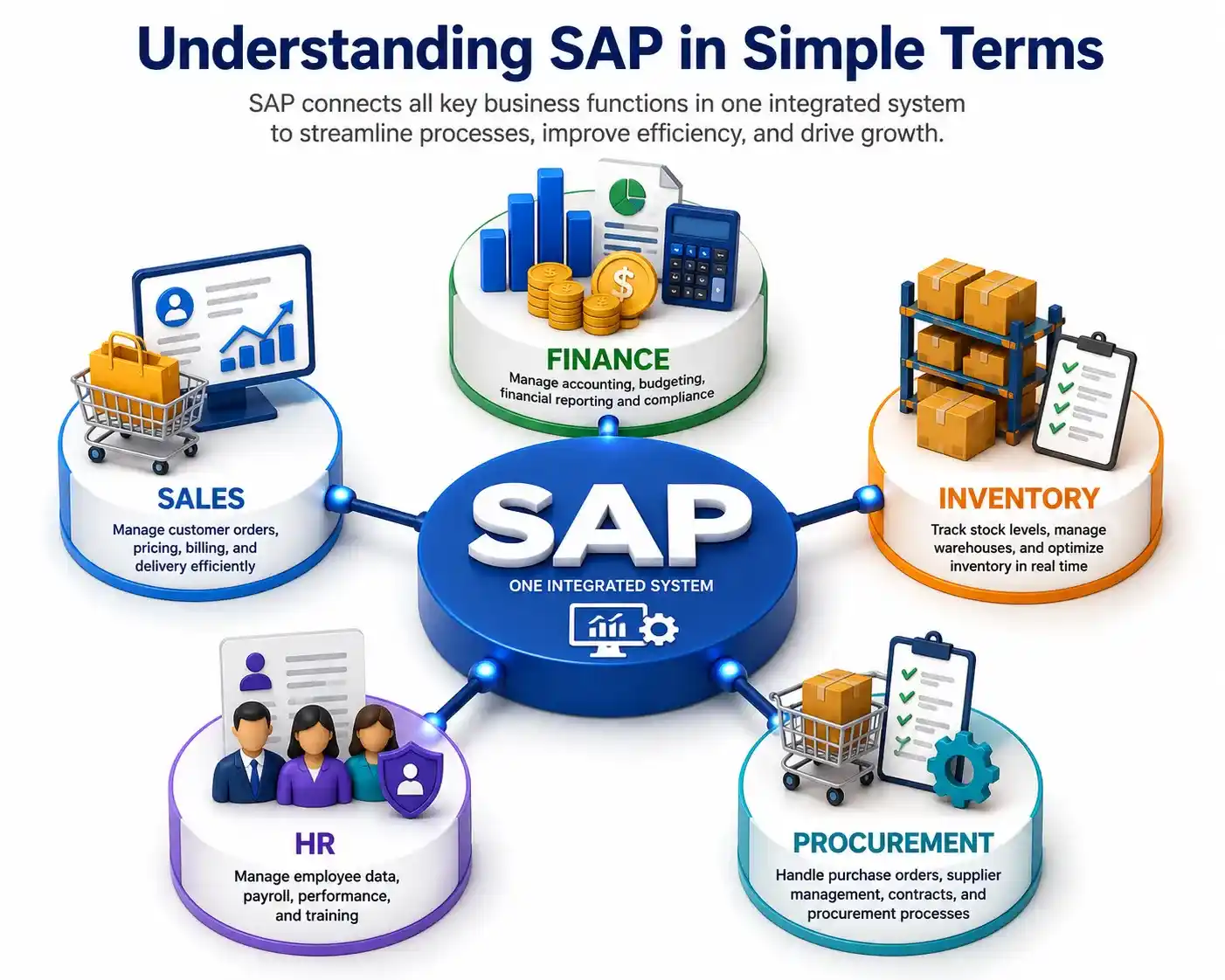
Understanding SAP in Simple Terms
SAP is business management software that allows organizations to manage multiple business processes from one centralized system. Instead of using separate applications for finance, sales, procurement, inventory, and human resources, SAP brings everything together on a single platform.
For example, when a customer places an order:
- The sales team records the order in SAP.
- Inventory levels are updated automatically.
- Finance teams receive billing information instantly.
- Warehouse teams get delivery instructions.
- Management can track the entire process in real time.
This seamless flow of information helps organizations improve productivity and reduce operational inefficiencies.
How Companies Use SAP in Daily Operations
SAP helps organizations streamline and automate their everyday business activities by connecting different departments through a single integrated system. From managing finances and inventory to handling sales, procurement, and human resources, SAP enables businesses to improve efficiency, reduce manual work, and make faster, data-driven decisions. Below are some of the key areas where companies use SAP in their daily operations.
Finance and Accounting Management
Finance is one of the most important areas where SAP is widely used. Organizations use SAP to manage:
- Financial accounting
- Budget planning
- Tax calculations
- Expense management
- Profit and loss reporting
- Financial compliance
With real-time reporting capabilities, finance teams can quickly analyze company performance and make informed decisions.
Example: A retail company with multiple branches can track sales revenue, expenses, and profitability across all locations from a single SAP system.
Procurement and Inventory Management
Businesses that deal with products, raw materials, or warehouse operations rely on SAP to manage procurement and inventory efficiently.
- Track stock availability
- Create purchase orders
- Manage supplier relationships
- Monitor warehouse activities
- Prevent stock shortages and overstocking
Example: A manufacturing company can automatically generate purchase requests when inventory reaches a predefined level, ensuring uninterrupted production.
Sales and Customer Order Management
SAP supports end-to-end sales processes by helping organizations manage:
- Customer orders
- Product pricing
- Quotations
- Billing and invoicing
- Shipping and delivery tracking
This improves coordination between sales, warehouse, and finance departments.
Example: An automobile company can track a vehicle order from booking to final delivery while maintaining complete visibility throughout the process.
Human Resource Management
Organizations also use SAP to simplify employee management activities such as:
- Employee record maintenance
- Payroll processing
- Recruitment management
- Attendance tracking
- Performance evaluations
- Training management
By automating HR processes, organizations can save time and improve workforce management.
Example: Large enterprises can process payroll for thousands of employees accurately and efficiently using SAP.
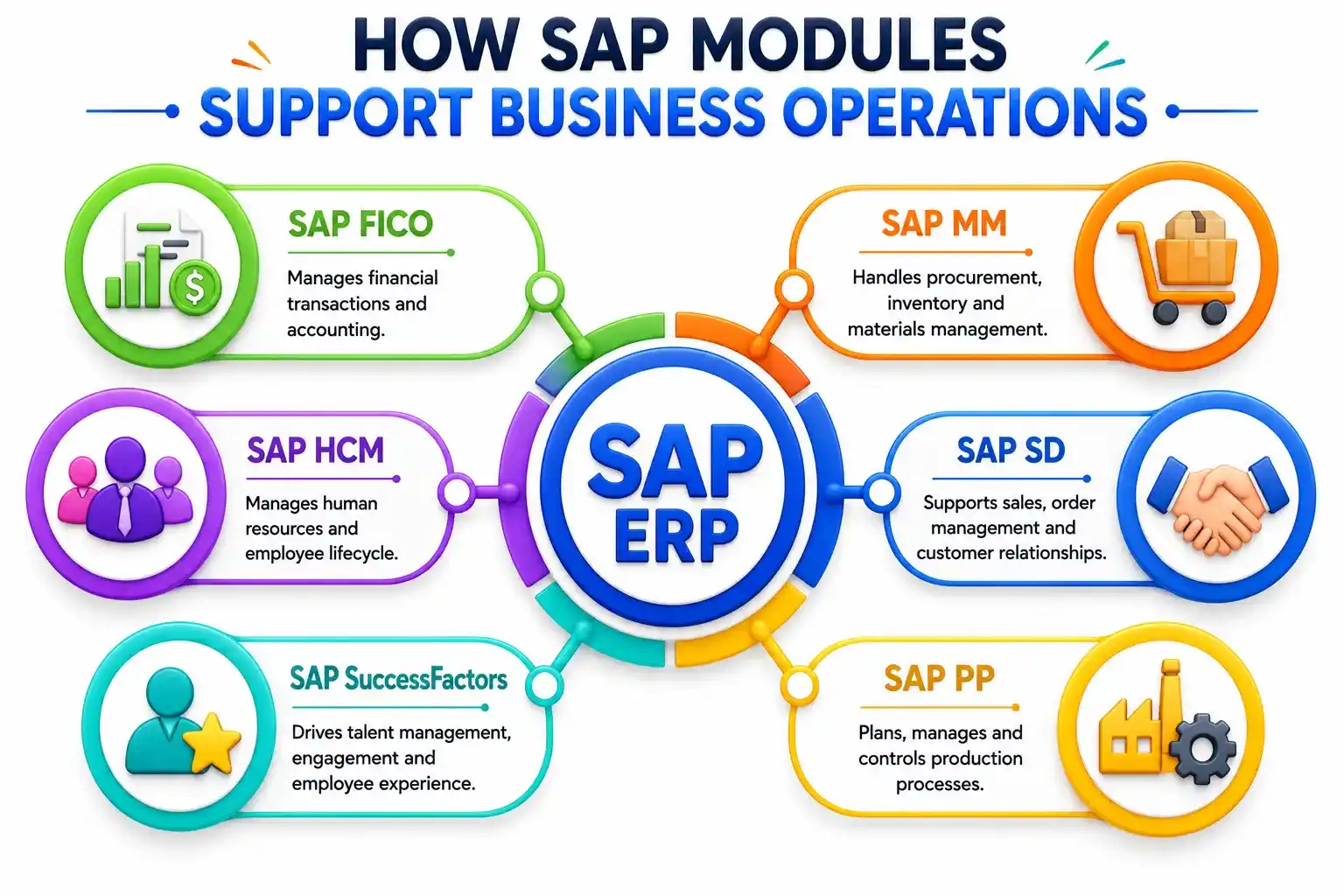
How SAP Modules Support Business Operations
SAP offers a wide range of specialized modules designed to support different business functions. Each module focuses on a specific area, such as finance, sales, procurement, production, or human resources, while remaining connected to the overall SAP system. This integration allows departments to share information seamlessly, improve collaboration, and ensure efficient business operations across the organization.
SAP FICO (Finance and Controlling)
SAP FICO helps organizations manage financial accounting, budgeting, cost control, financial reporting, tax management, and regulatory compliance. It enables businesses to track financial performance, monitor expenses, and make informed financial decisions through real-time reporting and analytics.
SAP MM (Materials Management)
SAP MM supports procurement, purchasing, inventory control, supplier management, and material planning processes. It helps organizations maintain optimal stock levels, manage vendor relationships, reduce procurement costs, and ensure the smooth availability of materials required for business operations.
SAP SD (Sales and Distribution)
SAP SD manages customer orders, pricing, quotations, billing, shipping, delivery tracking, and customer relationship processes. It helps businesses streamline sales operations, improve order fulfillment, enhance customer satisfaction, and maintain accurate sales records.
SAP HCM (Human Capital Management)
SAP HCM helps organizations manage employee information, payroll processing, recruitment, attendance tracking, performance evaluations, training, and workforce planning. It enables HR teams to automate routine tasks, improve employee management, and support overall workforce development and productivity.
SAP SuccessFactors
SAP SuccessFactor is a cloud-based Human Experience Management (HXM) solution that helps organizations manage modern HR processes more effectively. Companies use SuccessFactors for:
- Employee Central
- Recruitment and Onboarding
- Performance Management
- Learning and Development
- Compensation Management
- Workforce Analytics
SAP PP (Production Planning)
SAP PP is widely used by manufacturing companies to manage production planning, scheduling, resource allocation, and manufacturing processes. It helps organizations plan production activities efficiently, monitor production workflows, manage material requirements, optimize resource utilization, and ensure timely delivery of products while maintaining quality standards and reducing production costs.
One of SAP's greatest strengths is that all these modules work together, allowing information to flow automatically across departments.
Benefits of Using SAP in Business Operations
SAP offers numerous benefits that help organizations improve efficiency, productivity, and overall business performance. By integrating different departments into a single system, SAP eliminates information silos and ensures smooth communication across the organization.
It provides real-time access to business data, allowing management teams to make faster and more informed decisions. SAP also helps reduce manual work through automation, improves data accuracy, enhances compliance, and supports business growth. Whether a company is managing finance, procurement, sales, manufacturing, or human resources, SAP helps streamline operations and create a more efficient working environment.
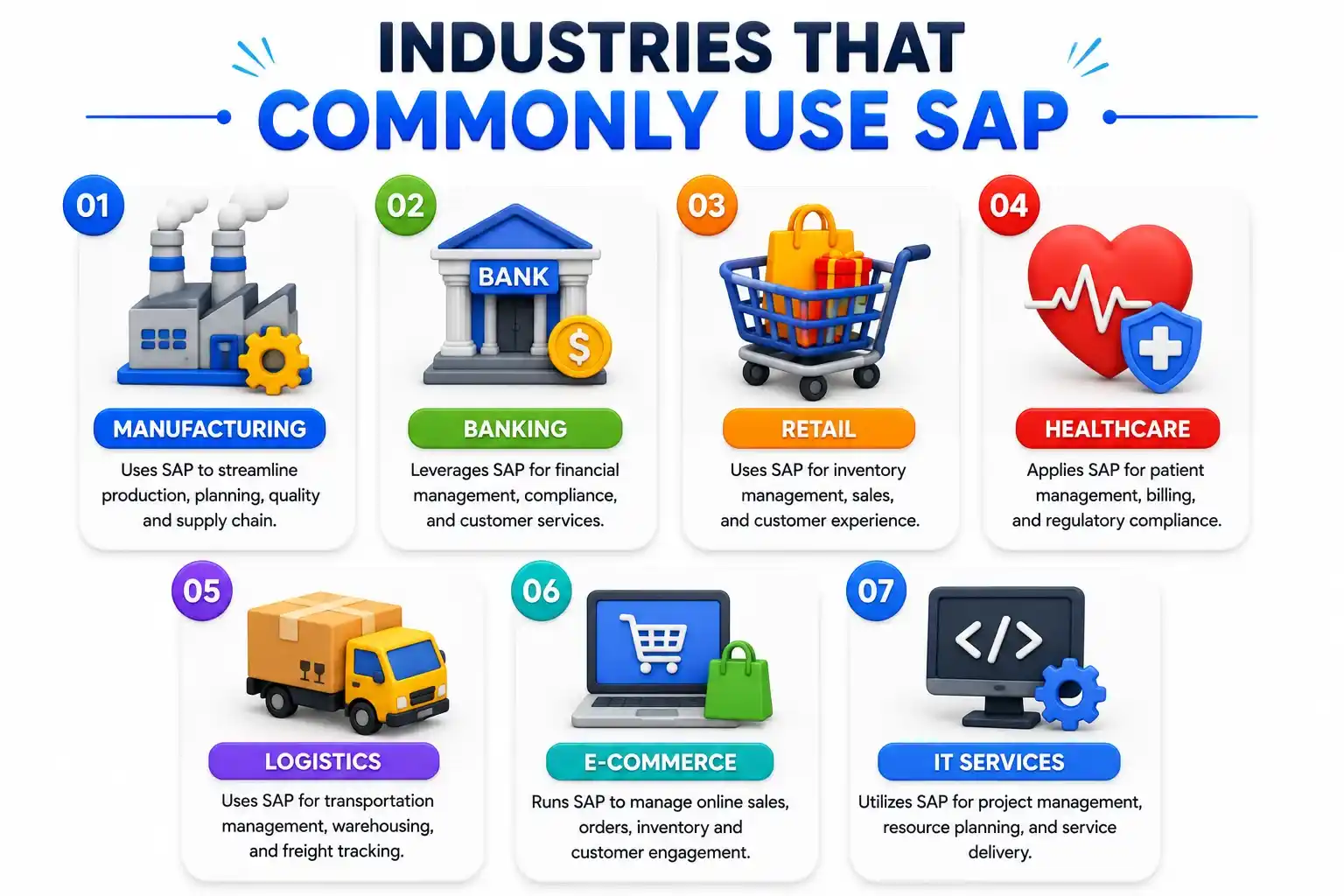
Industries That Commonly Use SAP
SAP is used across a wide range of industries because almost every business requires efficient process management, real-time data access, and seamless coordination between departments. From managing finances and inventory to handling sales, procurement, manufacturing, and human resources, SAP helps organizations streamline operations and improve overall business performance.
SAP is widely used across industries such as manufacturing, retail, banking and financial services, healthcare, logistics and supply chain, e-commerce, IT services, telecommunications, automotive, and pharmaceuticals.
These industries rely on SAP to streamline operations, improve process efficiency, manage business data, and support informed decision-making. From inventory management and financial reporting to customer service and workforce management, SAP helps organizations optimize their core business functions.
As a result, many multinational companies and large enterprises use SAP to manage complex operations across multiple locations and business units efficiently.
Why Businesses Prefer SAP
Businesses prefer SAP because it helps integrate multiple business functions into a single system, improving efficiency, accuracy, and collaboration across departments. With real-time data, automated processes, and centralized information management, SAP enables organizations to streamline operations, reduce costs, and make faster, data-driven business decisions.
Better Integration
SAP connects different departments and business functions through a single integrated platform, enabling seamless information sharing across the organization. This ensures that data flows automatically between teams, improves collaboration, reduces communication gaps, and helps businesses operate more efficiently with greater visibility into their processes.
Improved Accuracy
SAP automates routine business processes, reducing manual errors and improving data consistency across departments. This helps organizations maintain accurate records and ensures that critical business information is reliable and up to date.
Faster Decision-Making
With real-time access to business data and reports, SAP enables managers and executives to make informed decisions quickly. Accurate insights into operations, finances, and performance help organizations respond faster to changing business needs.
Increased Productivity
By automating repetitive tasks and streamlining workflows, SAP allows employees to focus on strategic and value-driven activities. This improves overall productivity and helps teams work more efficiently.
Growing Demand for SAP Professionals
As digital transformation continues across industries, the demand for SAP professionals is steadily increasing.
Organizations require skilled professionals who understand both SAP systems and business processes.
Popular SAP career roles include:
- SAP Functional Consultant
- SAP Technical Consultant
- SAP Business Analyst
- SAP Support Analyst
- SAP Project Coordinator
- SAP Implementation Consultant
- SAP Project Manager
Professionals with SAP expertise often enjoy strong career growth opportunities and competitive salary packages.
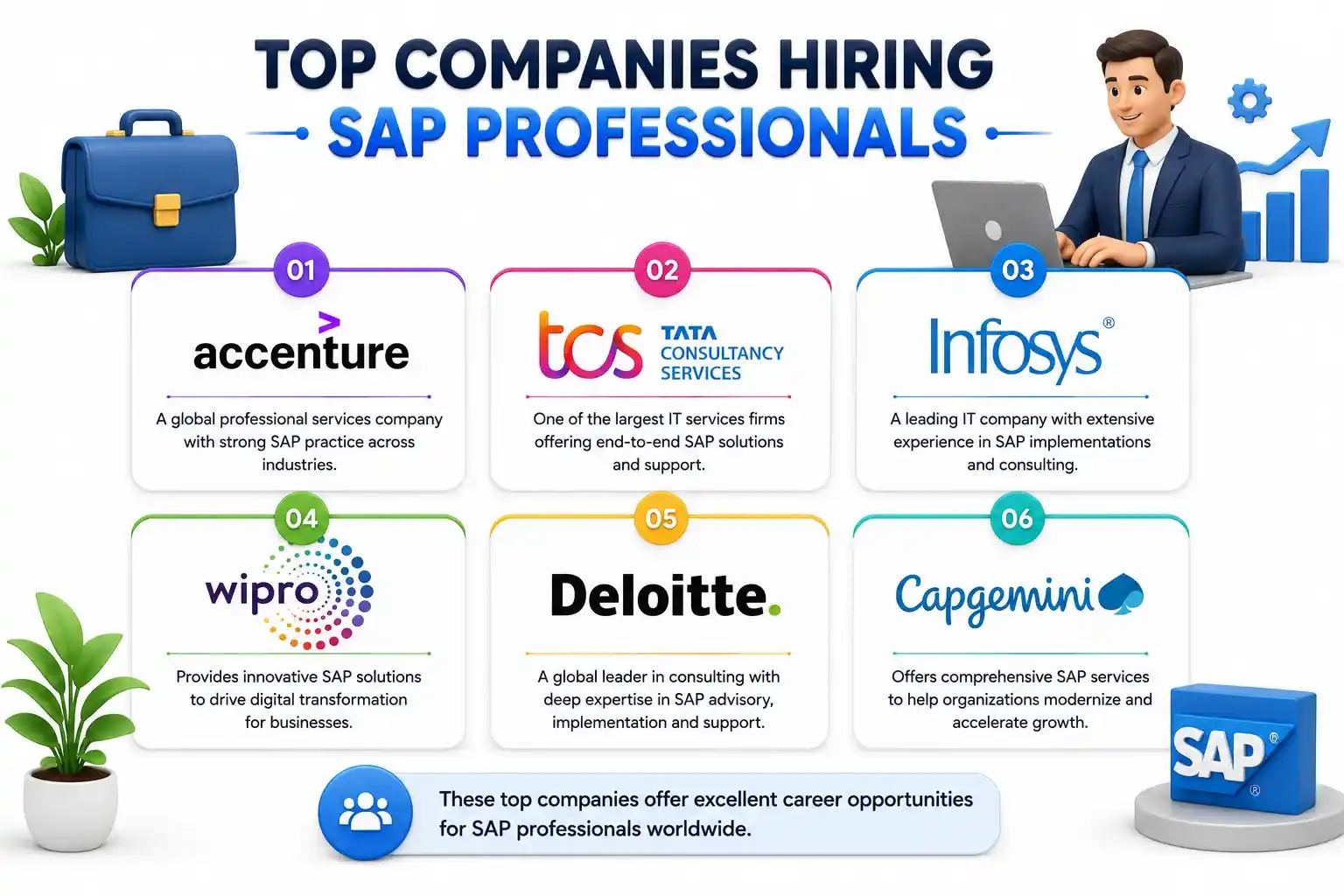
Top Companies Hiring SAP Professionals
Many leading organizations across industries use SAP to manage their business operations and regularly hire SAP professionals to support their ERP initiatives. Global consulting firms and technology companies such as Accenture, Tata Consultancy Services, Infosys, Wipro, Capgemini, Deloitte, IBM, Cognizant, HCLTech, and Tech Mahindra actively recruit SAP professionals for implementation, consulting, support, and digital transformation projects
Large enterprises including Reliance Industries, Tata Steel, Larsen & Toubro (L&T), Amazon, and Flipkart also rely on SAP solutions to streamline finance, procurement, supply chain, inventory, sales, manufacturing, and human resource processes.
In India, major hiring hubs for SAP professionals include Bengaluru, Hyderabad, Chennai, Noida, Pune, Mumbai, Gurugram, and Kolkata, where multinational companies and large enterprises frequently recruit SAP consultants, business analysts, and ERP specialists.
As organizations continue investing in automation, cloud ERP, and business process optimization, demand for SAP talent is expected to remain strong across these major technology and business centers.
Why SAP Training Is Important for Career Growth
As more organizations adopt ERP systems, the demand for professionals with SAP knowledge continues to grow. However, understanding SAP requires more than theoretical knowledge. Structured SAP training helps learners gain practical exposure to business processes, system navigation, and module-specific functionalities.
SAP training can help individuals:
- Understand real-world business operations
- Learn industry-standard ERP practices
- Gain hands-on experience with SAP modules
- Improve job readiness and employability
- Prepare for SAP certification paths
- Build confidence for implementation and support projects
- Explore career opportunities across multiple industries
For students, freshers, and working professionals, SAP training can provide a strong foundation for building a long-term career in the ERP and enterprise technology domain.
With the growing demand for ERP professionals, learners are increasingly opting for
SAP Training in Hyderabad, SAP Training in Bangalore,
SAP Training in Noida, Pune, Chennai, and other major technology hubs to gain hands-on experience, industry exposure, and job-ready SAP skills.
Future Scope of SAP in 2026 and Beyond
The future of SAP remains strong as organizations continue investing in digital transformation, cloud technology, automation, and intelligent business solutions. Companies are increasingly looking for integrated platforms that can help them improve efficiency, manage data effectively, and support business growth.
- Growth of cloud-based SAP solutions
- Increasing demand for SAP SuccessFactors and HR transformation
- Expansion of business process automation
- Greater use of AI and analytics within ERP systems
- Ongoing ERP modernization projects
As businesses continue to modernize their operations, SAP professionals are expected to remain in high demand, making SAP one of the most promising career paths in the ERP industry.
Final Thoughts
The future of SAP remains strong as organizations continueSAP has become an essential part of modern business operations because it helps organizations manage finance, inventory, sales, procurement, manufacturing, and human resources through a single integrated platform. investing in digital transformation, cloud technology, automation, and intelligent business solutions. Companies are increasingly looking for integrated platforms that can help them improve efficiency, manage data effectively, and support business growth.
By improving efficiency, enhancing collaboration, and providing real-time business insights, SAP enables organizations to operate more effectively in today's competitive environment.
As businesses continue investing in ERP systems and digital transformation initiatives, SAP skills will remain highly valuable for students, freshers, finance professionals, and working professionals seeking long-term career growth.
FAQ
1. What is SAP used for?
SAP is used to manage business operations such as finance, procurement, inventory, sales, human resources, and reporting through one integrated ERP platform.
2. What are the most popular SAP modules?
Some of the most popular SAP modules include SAP FICO, SAP MM, SAP SD, SAP HCM, SAP PP, and SAP ABAP.
3. Why do companies use SAP?
Companies use SAP to automate processes, improve efficiency, integrate departments, reduce errors, and gain real-time visibility into business operations.
4. Is SAP a good career option?
Yes. SAP offers excellent career opportunities because organizations across industries require professionals with ERP and business process expertise.